


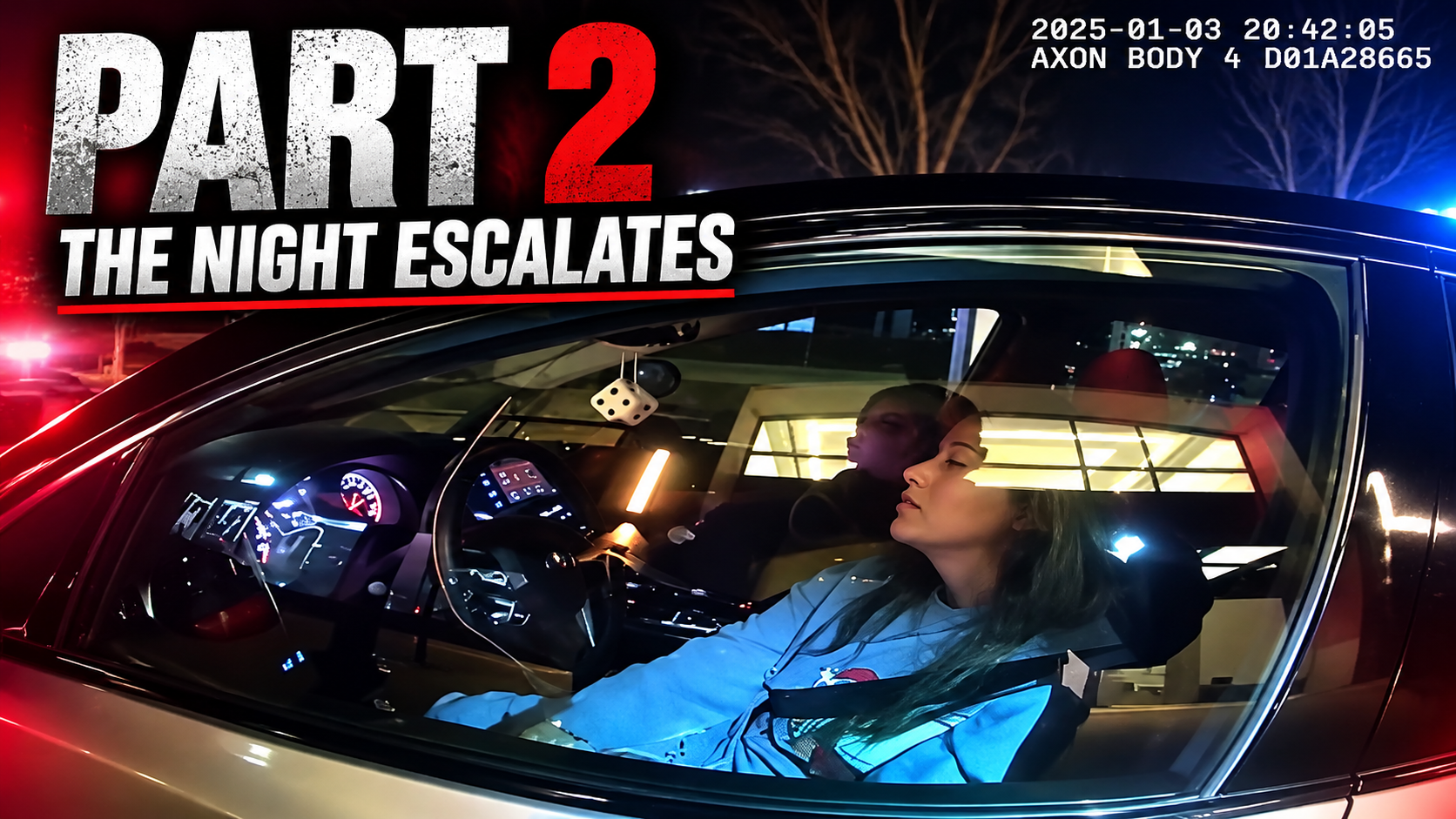
What began as a welfare check on a woman apparently slumped over inside a vehicle had already turned into a tense encounter with police. But as the officers continued their investigation, the situation became increasingly complicated.
The woman had repeatedly tried to explain herself, while officers attempted to determine whether she was capable of safely operating the vehicle. By this point, the flashing lights had attracted attention, another person had become involved in the encounter, and the woman appeared frustrated with nearly every instruction she was given.
But the most serious part of the night was still ahead.
Officers Wanted One Thing: A Clear Answer
After getting the woman out of the vehicle, officers began speaking with her away from the driver’s seat.
Their concern appeared to center on what they had observed before approaching the car. The woman had reportedly appeared to be slumped over, and officers were now trying to understand why.
Was she simply tired?
Was she experiencing some kind of medical problem?
Or was there another reason she had been sitting that way?
The woman insisted that she could explain herself. At times, she appeared convinced that the officers were making the situation much bigger than it needed to be.
But from the officers’ perspective, an explanation alone wasn’t necessarily enough.
A person sitting behind the wheel who appears unable to remain alert can create an immediate public-safety concern. Once officers make that observation, they generally need to determine whether that person can safely drive away.
That was when the encounter moved toward a series of roadside instructions.
The Walk-and-Turn Test Changed the Tone
As the conversation continued, one of the officers told the woman that the next step would involve a walk-and-turn test.
The instruction itself was simple: listen carefully, stand where directed, and follow the officer’s movements in sequence.
But almost immediately, there was a problem.
The woman continued talking.
She questioned what the officers were doing. She appeared distracted by the people around her. Instead of simply waiting for the instructions to finish, she repeatedly interrupted the process.
The officer tried again.
The woman was told where to place her feet and how to position her arms. She was also instructed to remain in place until she was told to begin.
But the interaction kept breaking down.
At one point, the officer made the stakes unmistakably clear: continuing to ignore instructions could lead to her being arrested.
That warning changed the atmosphere.
This was no longer an informal conversation beside a parked car.
The woman was now standing in the middle of an active police investigation, and every decision she made was becoming increasingly important.
Then Someone Else Stepped In
The situation became even more complicated when a man approached and began communicating with the officers.
He appeared to know the woman and seemed concerned about what was happening.
From his perspective, he may have believed he was helping.
From the officers’ perspective, however, another person entering an already tense investigation created a new problem.
Officers repeatedly tried to control the scene.
The man was told not to interfere and to give the officers room to work. At one point, the woman also seemed more focused on what he was doing than on the instructions she was receiving.
The encounter now had several moving parts: the woman, the officers attempting to conduct their investigation, the vehicle, the woman’s belongings, and another individual asking questions and challenging what was happening.
The more chaotic the scene became, the less likely it seemed that the evening was going to end with everyone simply walking away.
Her Purse Became Another Point of Conflict
During the encounter, officers also attempted to manage the woman’s personal belongings.
Her purse quickly became another source of disagreement.
She appeared uncomfortable with officers handling it and repeatedly focused on where the bag was going.
At the same time, officers were trying to maintain control of the scene while determining what would happen next.
The man standing nearby also became involved in the discussion about her property.
The woman wanted answers.
Who was taking her purse?
Where was it going?
Would someone she trusted be allowed to keep it?
But the officers were now operating under a different priority. Their immediate concern was the investigation and keeping everyone involved under control.
The woman’s frustration continued to grow.
And then the officers made their decision.
“The Officer Is Arresting You”
The mood changed instantly.
The woman was informed that she was being placed under arrest.
Any possibility that this would end as a warning or a brief roadside conversation was gone.
Officers moved closer and began taking physical control of her.
She protested.
She questioned why she was being arrested and continued arguing about what had happened moments earlier.
The man nearby also reacted, but officers made it clear that he needed to stay out of the arrest.
For the woman, this appeared to be the moment when the seriousness of the situation finally became impossible to ignore.
Minutes earlier, she had been standing beside her car debating instructions.
Now she was in police custody.
But even after being detained, the confrontation didn’t end.
At the Station, the Arguments Continued
After being transported away from the scene, the woman was eventually brought into a police facility.
The surroundings had changed completely.
The flashing emergency lights were gone.
The street, the vehicle and the bystanders were no longer around her.
Instead, she was inside a controlled police environment where officers continued processing the incident.
Yet her frustration remained.
She continued questioning the officers and challenging their version of what had happened.
At several points, she returned to the same argument: she did not believe she had been given a fair opportunity to explain herself.
She also disputed aspects of why officers had approached her vehicle in the first place.
One recurring point appeared to involve where the vehicle had been stopped or parked.
From her perspective, the location apparently did not justify everything that followed.
But the officers’ concern seemed to extend well beyond the parking issue. What began the encounter was only one piece of a much larger investigation once officers observed her condition and began interacting with her.
That distinction appeared to be something the woman continued struggling to accept.
“You Didn’t Give Me an Opportunity”
As the booking process continued, the woman’s tone shifted between anger, frustration and disbelief.
She repeatedly claimed that officers had not allowed her enough time or opportunity.
At another point, she complained about discomfort around her shoulder while officers were handling her.
Officers continued attempting to guide her through the process.
For viewers, this is where the incident becomes particularly revealing.
On the street, the situation had been chaotic. There were police vehicles, flashing lights, a friend or companion nearby and constant distractions.
Inside the station, most of those distractions were gone.
Yet the confrontation continued.
That suggests the conflict was no longer just about the location of the traffic stop or the pressure of standing beside several police officers.
The woman fundamentally disagreed with how the entire encounter had been handled.
And the officers clearly believed they had already given her numerous opportunities to cooperate.
Neither side appeared willing to change its position.
One Decision After Another
Incidents like this rarely turn on a single dramatic moment.
Instead, they often develop through a chain of small decisions.
The initial decision to remain inside the vehicle.
The way someone responds when an officer approaches.
Whether instructions are followed immediately.
Whether the person continues arguing during an investigation.
Whether another person enters the scene and begins interfering.
And finally, how someone responds after being warned that failing to cooperate could result in an arrest.
Any one of those moments may appear insignificant on its own.
Together, however, they can completely change the outcome of an encounter.
By the time the woman arrived at the police facility, the night looked very different from how it had begun.
She was no longer simply a woman sitting inside a car.
She was now a detainee being processed after a lengthy and increasingly confrontational police encounter.
But One Major Question Remained
The body-camera footage shows the confrontation, the roadside investigation and the woman’s eventual detention.
What it does not establish on its own is the complete legal outcome that followed.
Being detained or arrested does not automatically establish guilt, and the footage alone does not confirm the final disposition of any potential charges.
That would depend on what officers documented, what evidence was collected and what happened after the body-camera recording ended.
Still, one thing is clear from the footage:
The encounter escalated dramatically.
What initially appeared to be officers checking on a woman inside a vehicle turned into an extended investigation, a roadside test, repeated warnings, a confrontation involving another person, an arrest and a tense trip through the booking process.
And even at the station, she remained convinced that the officers had gotten the situation wrong.
The police appeared equally convinced that her own behavior had left them with little choice.
So the question viewers are left with is not simply why did the police arrest her?
It’s something more complicated:
At what point could this entire encounter have ended differently?
Was it when officers first approached the car?
When she was asked to step away from the vehicle?
When the field sobriety instructions began?
Or when she received the final warning to follow directions?
By the end of the footage, that opportunity—wherever it may have been—was already gone.
And now, the next chapter would no longer play out on the street.
It would play out in the legal system.